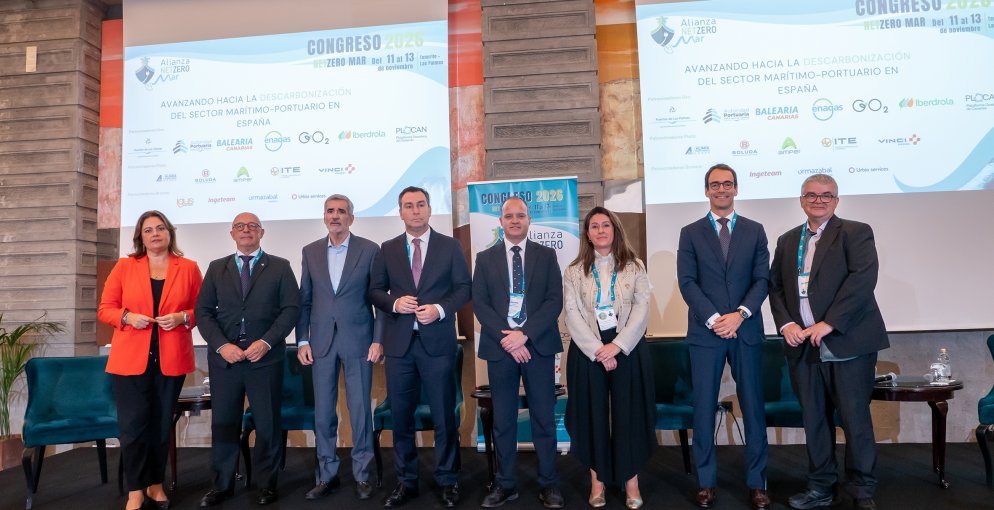
- The awards ceremony took place as part of the 4th Net-Zero MAR Congress, held in Tenerife and Las Palmas de Gran Canaria
- The congress brought together more than 200 professionals and around a hundred companies from the maritime and port sector to discuss the roadmap for decarbonisation
- The summit concluded after three days devoted to European and international regulations, the Action Plan for the Decarbonisation of Maritime Transport, emerging technologies, green corridors, port electrification and the OPS
- The Alliance presented its Study and Web-Based Visualisation Tool on Renewable Energy in Ports, as well as the results of its OPS Study, which quantify the planned investments and capacities within the Spanish port system
Las Palmas de Gran Canaria, 17 November 2026. – Last Friday, the Net-Zero MAR Alliance brought the fourth edition of its annual conference to a close, an event that has firmly established itself as the leading national forum for decarbonisation and sustainability in the maritime and port sector. Over three intensive days, the event brought together around a hundred companies and institutions and more than 200 professionals in Tenerife and Gran Canaria, with one of its highlights taking place on the evening of Thursday 12 November with the celebration and presentation of the first Net-Zero MAR Awards.
These awards were created with the aim of recognising projects and achievements that contribute to transforming the sector through the implementation of solutions, technological innovation and a sustained commitment to the energy transition. In this first edition, the winners were Endesa in the “Net-Zero MAR Implementation Project” category for its OPS Cádiz Cruise initiative, which enables cruise ships calling at the Alfonso XIII quay in the Port of Cádiz Bay to switch off their auxiliary engines and reduce emissions, noise and vibrations; Baleària in the “Net-Zero MAR Transformation Track Record” category for more than a decade of initiatives relating to its vessels, fuels and operations; and Tecnalia in the “Net-Zero MAR Innovation Project” category for its Apolo project, which is developing a membrane reactor to produce hydrogen from ammonia on board the vessel.
The opening of the conference programme, held on the first day in Las Palmas de Gran Canaria, reaffirmed the sector’s role as a sustainable economic driver. Javier Cervera, president of the Net-Zero MAR Alliance, highlighted in his speech the congress’s aim to “establish itself as the leading forum for progress towards cleaner, more efficient maritime transport that is aligned with European and international climate targets”. The opening panel also featured the support and contributions of Beatriz Calzada, chair of the Las Palmas Port Authority; Pedro Suárez, chair of the Tenerife Port Authority; Adolfo Utor, chair of Baleària; José Joaquín Hernández, chair of PLOCAN; and Germán Carlos Suárez, chair of Alimia Shipyards. The sector called for ambitious yet achievable targets, technology neutrality, regulatory stability and for the revenue generated by the ETS to be channelled back into the maritime transition itself.
Next, Gustavo Santana, Chair of Puertos del Estado, delivered the opening address, in which he highlighted the key role of ports in the maritime and port sector’s commitment to decarbonisation, the profound structural change brought about by port electrification, and the strategic importance that the islands have acquired for Europe.
European and international regulations and the National Decarbonisation Plan
The conference analysed the implications of European and international regulations. Miguel Núñez, Transport Councillor for Spain’s REPER delegation to the EU, addressed the review of the ‘Fit for 55’ package, developments in the ETS and AFIR, and the Sustainable Maritime Alternative Propulsion (SMAP) mechanism.
For his part, Benito Núñez, Secretary-General for Air and Maritime Transport, presented the Action Plan for the Decarbonisation of Maritime Transport in Spain, aimed at strengthening maritime industrial sovereignty and promoting green corridors and energy hubs in ports. He also announced a grant programme worth 250 million euros over five years, with the first call for applications expected in 2027. The subsequent debate covered hybridisation, batteries, LNG and biogas, wind-assisted propulsion, on-board carbon capture and the potential of other emerging technologies.
Final day: renewable energy, port electrification and the Vocational Training Hub
The final day focused on applied solutions. The Alliance presented the Study and Web Portal on Renewable Energy in Ports, produced by CPS, which identifies 55 MW already installed, 367 MW planned and 29 pilot projects, 40 per cent of which are linked to offshore installations.
The session also addressed the role of Spanish ports in offshore wind power, with projects supported by PORT-EOLMAR, and the power requirements for electrifying terminal machinery. ABB, Schneider Electric, Siemens and Vinci Energies agreed that energy management must be based on microgrids and EMS systems, integrate cybersecurity and provide a modular, scalable, mobile, flexible and digital solution.
In the area of talent, Lydia Berrocoso, Deputy Director-General for Dual Training and Business Relations at the Ministry of Education, Vocational Training and Sport, presented the Sustainable Maritime Mobility Vocational Training Hub, designed to turn technological and energy transformation into new opportunities for training, talent and quality employment within the sector.
The technical closing session was devoted to the onshore power supply (OPS) for ships. The CNMC, Redeia and OMIE analysed grid regulation, electricity planning and the competitiveness of the supply. The 2025–2030 Plan aims to facilitate the connection of 47 GW of new demand, of which 1.8 GW relates to OPS and other port-related demands. The Alliance’s OPS Study estimates that by 2030 the Spanish port system will achieve compliance with the AFIR Regulation of between 53 per cent and 100 per cent, depending on the maturity of the projects and the implementation of the grid, with total requirements exceeding 1,034 MVA and an investment of 1,000 million euros.
Finally, Javier Cervera and Eva Pérez, the Alliance’s president and secretary-general, brought the conference to a close by emphasising that the sector-wide debate has shifted from questioning whether decarbonisation is necessary to focusing on how to achieve it: how to generate energy, roll out infrastructure, adapt regulations, operate the new solutions and train the people who will be responsible for running them.
Parallel technical visits
The conference’s impact extended across Tenerife and Gran Canaria. The first day included visits to DISA’s hybrid renewable energy plant in Arico, the ENEPORTS project, the Blue Innovation Centre in Granadilla and ITER. Participants then travelled to Las Palmas aboard the Mercedes Pinto operated by Baleària Canarias and toured its terminal. The programme was rounded off with visits to the Port of Las Palmas, Astican and the Canary Islands Institute of Technology, where projects relating to renewable energy, hydrogen, ammonia, methanol and biofuels were presented.