- The initiative, with a budget of 1.3 million euros co-financed by the AVI, aims to validate a modular and efficient naval platform
- Fundación Valenciaport will define the technical requirements and economic viability of the on-quay electric charging infrastructure
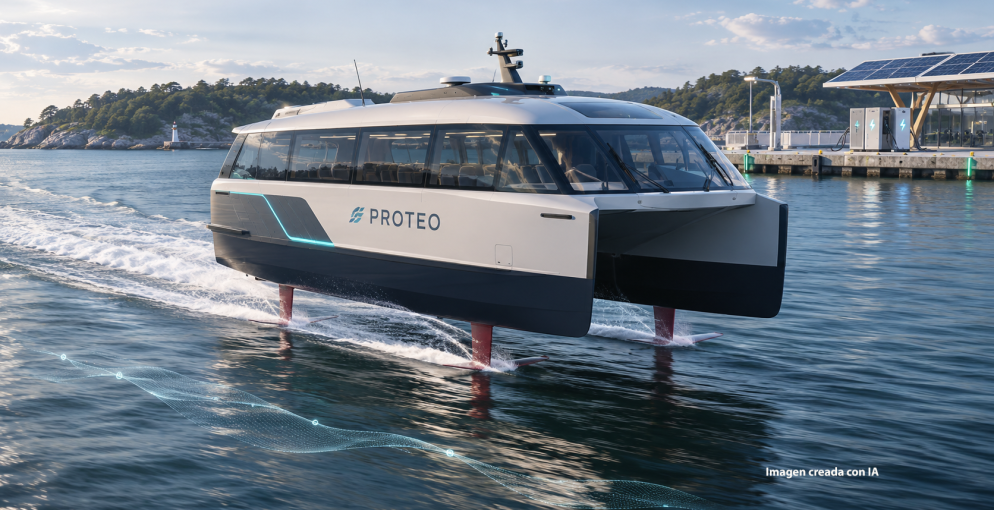
Valencia, 12 November 2026.- Fundación Valenciaport has begun work on the PROTEO project, ‘Reconfigurable Naval Platform Optimised through Electric Propulsion Technologies and the Integration of Hydrofoils’, a strategic initiative developed in collaboration with the companies Caponnetto Hueber (coordinator), Ubitech Limited, Abervian and the Plastics Technology Institute (AIMPLAS). The consortium’s main objective is to design and validate a new generation of efficient, modular and scalable naval platforms intended for ferry-type vessels.
PROTEO’s technological proposal is based on three innovative pillars: the integration of electric propulsion systems, the use of advanced hydrofoils made from sustainable materials, and the intelligent monitoring and forecasting of wave conditions. At the same time, the project will develop shore-based power supply solutions to maximise energy efficiency, reduce emissions and enhance both the stability and operational reliability of vessels in maritime and port environments.
The role of Fundación Valenciaport: electrification and economic viability
Within the consortium, Fundación Valenciaport contributes its knowledge of the port ecosystem and actual operating conditions to ensure that electrification solutions are viable within the existing infrastructure. Firstly, the organisation will establish the exact technical requirements for the charging infrastructure – such as voltage, current, power and energy – tailoring them to the different types and sizes of vessels, as well as their actual port call durations.
Once this demand has been characterised, the technical team will analyse the best options for integrating these systems into both the port’s conventional electricity grid and the future medium-voltage shore-side power supply infrastructure (OPS).
Finally, the Foundation will assess the economic viability of the system by evaluating the necessary investments, operational and maintenance costs, and the revenue threshold required to ensure a positive return on investment throughout the facility’s useful life. This financial analysis, applied to the use case of battery recharging in port, will enable the design of a robust and scalable business model for ferries of different sizes.
The PROTEO project, which will run until December 2028, has a total budget of 1.3 million euros, co-funded by the Valencian Agency for Innovation (AVI).